

Connection Detection: Helping Kids See Who’s on Their Team
Connection changes everything.
The moment a child feels connected to someone—even just a little—their thoughts soften. Their body relaxes. Their story about the other person shifts. What once felt like me versus them becomes something closer to we’re not so different after all.
And here’s the surprising part: most disconnection isn’t about who people really are. It’s about where we’re looking from.
Why Connection Is a Superpower
Humans are wired for relationships. For kids especially, meaningful connection builds a sense of belonging, buffers stress, and plays a huge role in how identity forms. When children feel connected, they’re more resilient. More open. More willing to try again after things go wrong.
Connection also grows empathy. When kids can see how they’re similar to others (even those who feel “different”), judgment softens. Curiosity steps in. And suddenly, the world feels a little less threatening and a lot more navigable.
Belonging vs. Fitting In
Brené Brown says it best: “Fitting in is becoming who you think you need to be to be accepted. Belonging is being accepted for who you are.”
When a child feels like they have to change themselves to be liked, that’s fitting in. It’s fragile, exhausting, and temporary.
But belonging? That’s the real thing. When kids feel like they belong, they can be themselves — quirks, imperfections, and all — and still feel part of something bigger.
Here’s the beautiful part: sometimes belonging doesn’t come from changing yourself. It comes from changing your perspective.
That’s where the Connection Wheel comes in.
The Connection Wheel: Who’s on Your Team Right Now?
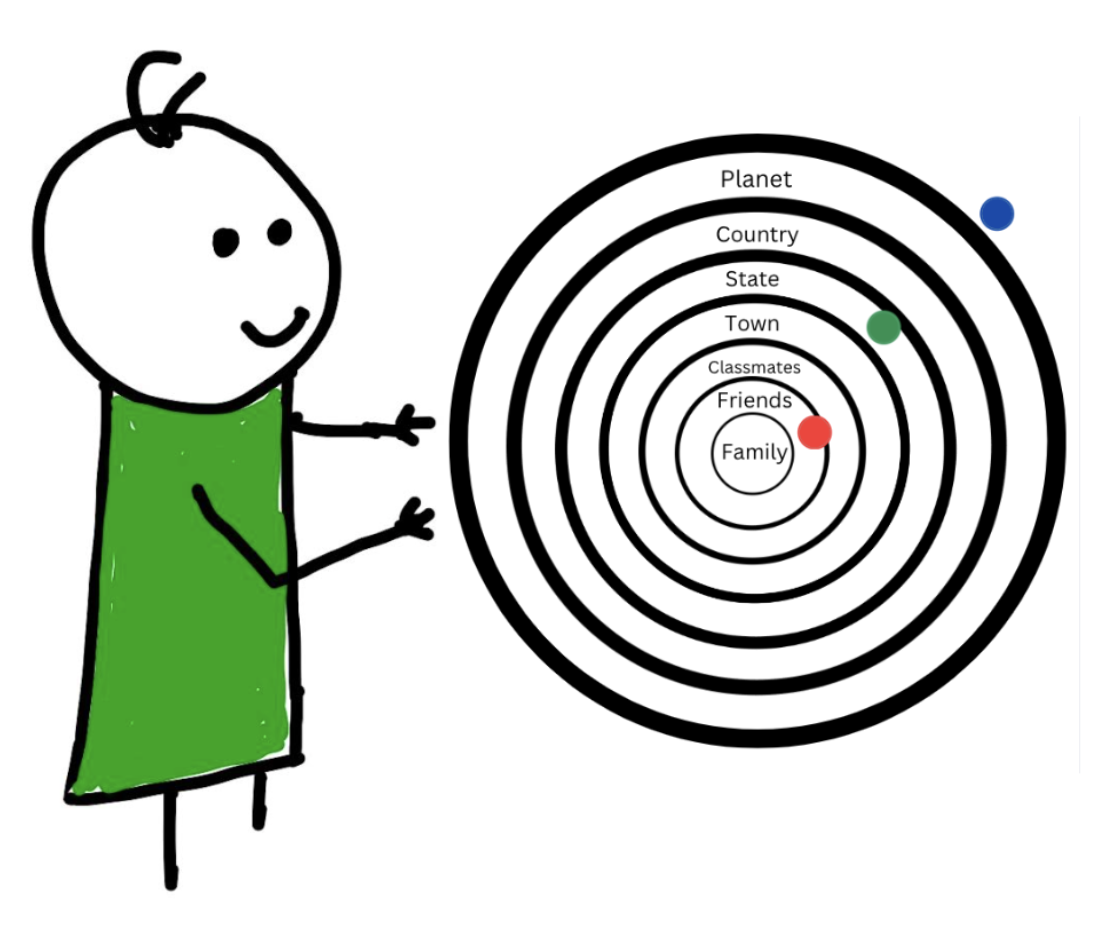
One simple way to help kids understand connection is to make it visual. I like to use something called the Connection Wheel.
Imagine a target with many rings.
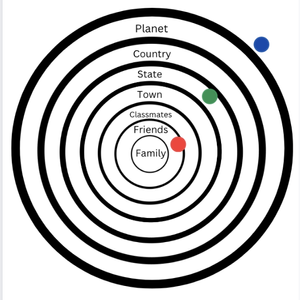
At the very center is the Red Dot. This is your child’s inner circle—family and close friends. These are the people who feel like my team. Everyone else can sometimes feel like not my team. Think lunch tables at school or tight friend groups on the playground.
The next ring out is the Green Dot. This includes people your child doesn’t know personally but shares something with—kids from the same school, people in the same town, fans of the same team. There’s already a thread of connection here, even if it doesn’t always feel obvious.
The outer ring is the Blue Dot—Team Earth. This is the widest view. When you zoom all the way out, every human is on the same team. Different languages, looks, beliefs—but the same planet, the same basic needs, the same human emotions.
Here’s the big idea:
We are always connected. Disconnection is usually a matter of perspective.
The “teams” we draw are imaginary, and they can change the moment we zoom in or out.
How to Teach This to Kids
This works best in real moments, not long explanations.
Start by helping your child name the ring they’re seeing from.
You might ask, “Right now, which team does this feel like—Red, Green, or Blue?”
If they’re upset with a classmate who feels very much not on my team, help them gently slide the lens outward. Same school? Same town? Same planet?
Then ask what changes.
Kids often notice it themselves: the tight feeling loosens, anger cools, and curiosity sneaks in where defensiveness used to live.
Next, invite them to collect similarities.
“What are three things you might share with this person?”
A favorite food. A pet. A fear. A goal. A family dynamic.
Similarity hunts build empathy fast.
You can also bring in Team Earth language when conflict pops up:
“Let’s try a Blue Dot moment. What would Team Earth do here?”
Try some simple phrases:
“They’re a human having a hard moment.”
“I can disagree and still be kind.”
How Zooming Out Builds Belonging
Let’s say your child feels left out at school. The girls in her class have their own group, and she doesn’t feel like she fits in. It hurts — because fitting in often means trying to change yourself to match someone else’s idea of “enough.”
But what if she doesn’t have to fit in to feel like she belongs?
What if she simply zooms out?
When she widens her circle to include her entire class — and then her school — she’s suddenly on a much bigger team. She hasn’t changed a single thing about herself. She’s just changed her vantage point. And with that new view, she belongs.
That’s the power of connection detection. It teaches kids that belonging doesn’t come from blending in — it comes from zooming out.
Why This Matters
Zooming out doesn’t erase differences. It enlarges common ground.
When kids learn to shift perspective, they don’t just handle conflict better; they feel a deeper sense of belonging, even outside their inner circle. They carry this skill with them into friendships, classrooms, online spaces, and eventually adulthood.
Connection becomes something they can create, not something they have to wait for.
And that may be one of the most powerful tools we can give them.
What Parents Can Say in the Moment
When emotions are high, scripts help.
You might try:
🌳 “Let’s check the Connection Wheel—what ring are you seeing from?”
🌳 “If we zoomed out one ring, how might that change how you act?”
🌳 “What might be true for them today that we can’t see?”
🌳 “What’s one thing you think they care about?”
🌳 “If you were on the same team for a project, how would you want to be treated?”
🌳 “Pick a ring—what’s one kind action from that ring?”

Next time your child feels “against” someone — a classmate, a teammate, even a sibling — have them find both of their positions on the Connection Wheel. Then encourage them to zoom out one level and ask, “How are we actually on the same team?”
They might discover that belonging isn’t about changing who they are — it’s about changing how they see.